TL;DR
- This article does two things.
- First, it explains the cultural and historical ideas behind key scenes in Episode 1 of SHOGUN (“Anjin”).
- Second, it turns that curiosity into a practical travel route around Ajiro (Atami, Shizuoka) and nearby Ito—places tied to the real “Anjin,” William Adams.
In 2024, the global entertainment world was shaken—in the best way. SHOGUN, a drama series based on James Clavell’s historical novel and led by Hiroyuki Sanada as both producer and star, premiered to major international acclaim. As a result, viewers were drawn to its scale, its attention to period detail, and a story built around cultural collision.
This story was adapted for television in 1980. However, the modern series is not a simple remake. Instead, it aims to show Japan around 1600 with unusual clarity: the atmosphere of the era, the logic of social order, and the way people understood life and death.
Episode 1, “Anjin,” is especially striking. To begin with, the story opens when a foreign ship reaches Japan and the English pilot John Blackthorne—later called “Anjin”—washes ashore in the Izu fishing village of Ajiro. From his first steps on land, the episode asks a blunt question: what happens when a person’s “common sense” stops working?
From there, Blackthorne enters a warrior society where discipline and brutality exist side by side. The stormy sea, quiet interiors, and sudden executions are not just dramatic spectacle. Rather, they are used to reveal cultural ideas that shaped the time.
I learned about this era through textbooks, of course. Even so, seeing it rendered so vividly shocked me—even as a Japanese viewer. In turn, it made me want to understand my own country more deeply.
With that in mind, I’m writing from the perspective of a former tour conductor who guided travelers in Japan and abroad for many years. When you bring guests into an unfamiliar place, what matters is not only scenery. You also need words for the history and values beneath the surface. In that sense, SHOGUN works like an exceptional “textbook” of Japanese culture—and, at the same time, a guide to the difficulty (and fascination) of cross-cultural understanding.
Through Blackthorne—the ultimate outsider—the series also teaches modern audiences (including Japanese viewers) about layers of Japanese culture we may have half-forgotten.
What This Article Covers
- Bathing, cleanliness, and cultural assumptions
Why Blackthorne rejects the bath and fears “flux” (dysentery). A comparative look at 17th-century European and Japanese hygiene beliefs, including the Shinto-inspired idea of misogi (ritual purification). - The portrayal of death and the aesthetics of the samurai world
What shocking scenes—like boiling executions and seppuku—are meant to convey. Historical context for harsh punishments, and the Japanese concept of hara (the “belly”) as a seat of spirit and sincerity, contrasted with Western heart-centered symbolism. - Ajiro as “sacred ground”: fiction vs. reality, and why it’s worth visiting
The geographic character of real Ajiro in Izu versus the series’ filming locations in Canada. Plus, what to experience locally: famous dried fish culture and the essence of hot-spring life. - The real Anjin and Izu’s historical ties
What the series doesn’t fully explore: William Adams’ shipbuilding achievements in Ito, and a recommended route and stay experience for travelers who want to walk in his footsteps.
- Part1: Shogun Episode1 Shows Japan in 1600—A Deep Look at Cultural Collision
- 1.Where Beauty and Cruelty Meet: Boiling Executions and the Question of Seppuku
- 2.“Impure” West vs. “Pure” Japan: Bathing, Misogi, and Hygiene Beliefs
- Europe in the 17th century: disease, medicine, and fear of water
- 3.Communication Beyond Words: Bowing and “Behavior as Language” in a Hierarchical Society
- 4.Missionaries, Sailors, and Political Intrigue: Geopolitics and Religious Conflict
- 5.The Social Structure of Ajiro: “Public vs. Private” and a Community Under Watch
- Part2 Shogun Episode1: Sacred Izu-Ajiro Travel Guide to Anjin’s Footsteps
- 1.Fictional “Ajiro” vs. the real Ajiro: filming in Canada and the geography of Izu
- 2.Seeking Japan’s famous dried fish: Ajiro’s food culture and the Himono Festival
- Miura Anjin (William Adams): shipbuilding history and memorial sites in Ito
- 4.Staying in registered cultural-property ryokan: experiencing traditional aesthetics at Ochiairo and Arai Ryokan
- Access and a recommended itinerary: a “SHOGUN-inspired” pilgrimage (day trip to 1 night/2 days)
- Conclusion
Part1: Shogun Episode1 Shows Japan in 1600—A Deep Look at Cultural Collision
Episode 1, “Anjin,” captures a moment when two worldviews collide. On one side is “mysterious and frightening Japan,” seen through a Western lens. On the other is “unclean and dangerous foreigners,” as perceived by a society under intense pressure.
With that in mind, I’ll select symbolic scenes and explore their historical background and cultural meaning. I’ll also consider what the creators may be aiming to convey through each moment.
1.Where Beauty and Cruelty Meet: Boiling Executions and the Question of Seppuku
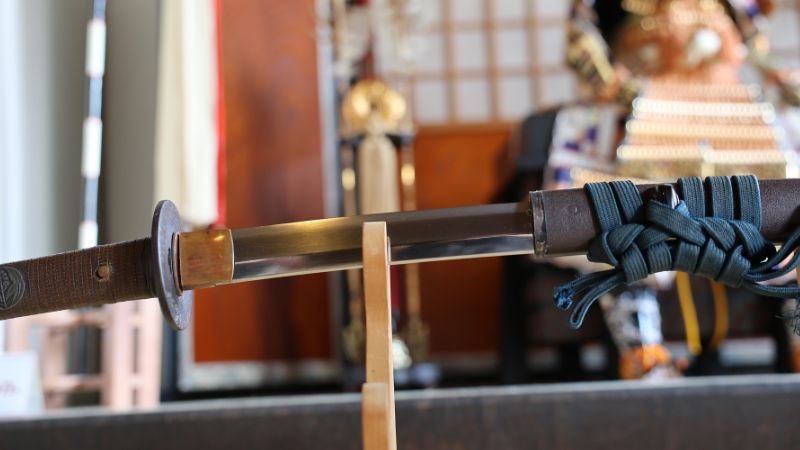
One of the most disturbing sequences in Episode 1 is the execution ordered by Kashigi Yabushige, the local lord of Ajiro. A member of Blackthorne’s crew is punished by being placed into a massive cauldron on the shore—an act depicted as “boiling to death.” This scene goes beyond shock value. It symbolizes power, the social order, a particular view of life and death, and Yabushige’s unsettling individuality.
The historical reality behind “boiling” (kamayude)
Episode 1, “Anjin,” captures a moment when two worldviews collide. On one side is “mysterious and frightening Japan,” seen through a Western lens. On the other is “unclean and dangerous foreigners,” as perceived by a society under intense pressure.
Against that backdrop, I’ll highlight a set of symbolic scenes and unpack their historical context and cultural meaning. Along the way, I’ll also consider what the creators may be trying to communicate through each moment.
English summary table
| Category | Details |
|---|---|
| Punishment name | Kamayude (boiling execution) |
| Historical context | A severe public punishment used from the Sengoku to Azuchi–Momoyama era |
| Famous example | Ishikawa Goemon (1594), executed in Kyoto (Sanjo riverbed area), often described as a public spectacle |
| Purpose | Deterrence through fear; a warning to others |
| Depicted in the drama | Yabushige executes a “foreign” sailor; framed as punishment and also driven by Yabushige’s personal fixation on death |
In the series, however, Yabushige’s behavior is not presented as mere cruelty. It’s tied to a warped curiosity: “What does a person feel at the moment of death?” He behaves in a way meant to disturb—treating another person’s suffering as background noise while indulging himself. The scene signals to the audience that Blackthorne has entered a moral universe where his familiar values do not provide safety or clarity.
Seppuku and the idea of hara (腹)
Across the series, seppuku (ritual suicide by cutting the abdomen) becomes a key theme. In many Western traditions, the “heart” symbolizes emotion and the soul. In Japanese language and culture, by contrast, the hara (belly) has long been associated with one’s true feelings, character, and integrity. You can see this in everyday expressions that suggest “revealing what’s inside” or “not being able to stomach something.”
From that perspective, seppuku is not framed simply as self-harm. Instead, it functions as a ritualized act of taking responsibility and demonstrating sincerity, honor, or innocence—however difficult that may be for an outsider to understand.
Kaishakunin (the “second”) and the ritual structure
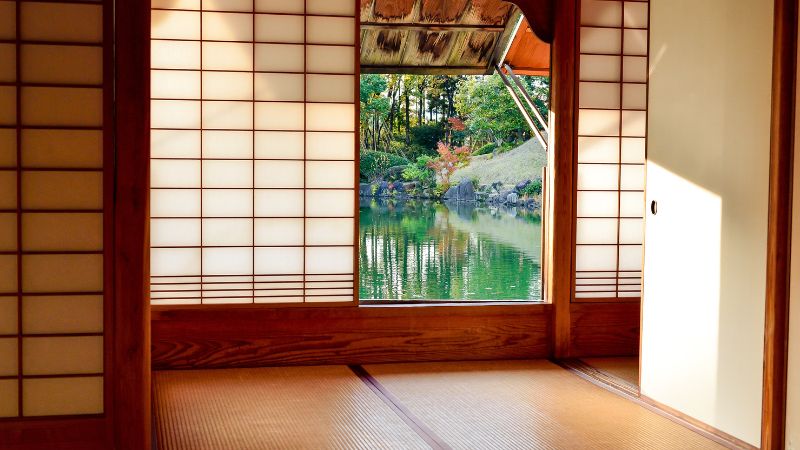
Historically, a kaishakunin (an assistant who ends the suffering) was often involved, because abdominal cutting does not usually cause immediate death. For that reason, seppuku developed as a structured ritual rather than a private, impulsive act. In the series, it is portrayed as a formal ceremony governed by strict etiquette—something Blackthorne experiences as “madness,” and yet, at moments, a kind of awe.
From Episode 1 onward, the drama suggests that for warriors of this era, “how one dies” is inseparable from “how one lives.” Even Yabushige seems constantly aware of the manner and place of death. As a result, this intense proximity to mortality shapes the show’s heavy tone and invites viewers to consider how different cultures create meaning around death.
2.“Impure” West vs. “Pure” Japan: Bathing, Misogi, and Hygiene Beliefs
In Episode 1, Blackthorne fiercely resists being forced into a Japanese bath, shouting that bathing will give him “flux” (commonly understood as dysentery). Modern viewers might wonder why he reacts so strongly. One useful way to understand the scene is to compare hygiene beliefs in Europe and Japan around 1600.
Europe in the 17th century: disease, medicine, and fear of water
In Europe at the time, epidemics such as plague were a constant threat. As a result, medical thinking often relied on the idea of “miasma”—the belief that bad air caused illness. Many people also believed that hot water opened the pores. In that logic, opened pores allowed harmful air to enter the body, which was thought to increase the risk of disease.
A “dry wash” culture
Because full-body bathing was sometimes seen as dangerous, many Europeans—aristocrats included—bathed rarely. Cleanliness was often managed by changing linen frequently, wiping the skin, and using perfume rather than immersing the body in water.
Fear of “flux” (dysentery)
Dysentery was a real and deadly risk in environments with contaminated water. For Blackthorne, being submerged in unknown water in a foreign land could feel not only unpleasant but genuinely life-threatening, based on the disease realities and beliefs of the time.
Japan: bathing and the spiritual logic of Misogi
In Japan, the Shinto concept of misogi (ritual purification with water) is foundational. In mythic narratives, cleansing in water is associated not only with removing physical dirt but also with washing away kegare—spiritual impurity. Water, in this worldview, carries sacred power.
Early visitors’ observations
Historical accounts by European missionaries and visitors to Japan often note, with surprise, that Japanese people bathed frequently and maintained clean homes and clothing by the standards of the time.
Infrastructure and urban hygiene
In later Edo Japan, large-scale waterworks supported major cities, and human waste was often collected and reused as fertilizer—an early form of urban recycling that helped reduce certain kinds of pollution compared with many contemporary European cities.
Comparative table (early 17th century, general trends)
| Comparison | Japan (late Sengoku to early Edo) | Europe (same era) |
|---|---|---|
| Bathing frequency | Frequent (daily to every few days); includes hot springs and washing outdoors | Rare; sometimes only a few times a year, or even less |
| Cultural meaning of water | Purity and cleansing; linked to misogi | Sometimes associated with illness risk (pores opening; miasma beliefs) |
| How “clean” was maintained | Washing with water or hot water | Changing linens, wiping, perfumes |
| Toilets and waste | Collection systems; reuse as fertilizer in many areas | Chamber pots; disposal often created sanitation problems in dense cities |
| Footwear indoors | Shoes removed; strong separation of inside/outside | Shoes often worn indoors; floors covered with straw or similar materials |
In the drama, the bathing scene is not only comic relief. It functions as a cultural initiation: a process by which a “foreign body” is brought into a “clean space” through purification. Being forced into the bath becomes a symbolic first step of transformation—whether Blackthorne wants it or not.
3.Communication Beyond Words: Bowing and “Behavior as Language” in a Hierarchical Society
Another source of Blackthorne’s confusion is nonverbal communication—especially bowing and ritualized manners. In a society where language is not shared, posture and gesture become a kind of social grammar. But in a warrior hierarchy, that grammar is strict.
Types of bows and what they signal
Ojigi (bowing) is not merely greeting; it measures distance, rank, and relationship. It can be roughly discussed through categories that correspond to different depths and contexts.
Examples commonly described in modern terms
- Eshaku (informal bow): around 15 degrees; casual greeting or acknowledgment
- Keirei (formal bow): around 30 degrees; standard expression of respect
- Saikeirei (deepest bow): 45 degrees to very deep; to superiors, serious apology, prayer-like respect
- Dogeza: kneeling with the forehead lowered to the ground; extreme submission, pleading, or apology
In Episode 1, villagers prostrate themselves before samurai to visually communicate overwhelming status difference. Blackthorne’s hesitation—whether to bow, how deeply, or not at all—becomes a struggle between pride and survival.
Breathing and stillness: the “pause” that carries meaning
Japanese etiquette often emphasizes not only the angle of a bow, but also timing, breath, and stillness. Because of that, a controlled pause can communicate sincerity and depth of respect. In the series, the Japanese cast—including Sanada—uses physical precision to create a quiet tension that fills the screen.
On a personal note, even today, bowing angles are sometimes taught in Japan as part of professional manners. Some people also describe bowing as “aligning the body” along the centerline. I’ve felt that, too—after a deliberate bow, my posture often feels steadier.
4.Missionaries, Sailors, and Political Intrigue: Geopolitics and Religious Conflict
Episode 1 is not simply “Japan vs. the West.” It also depicts conflict among Europeans—especially the religious and political rivalries that shaped trade and power in that era.
Proxy conflict: Catholic vs. Protestant interests
In the story’s framing, Blackthorne’s ship represents interests aligned with Protestant nations such as the Dutch and English. By contrast, the Portuguese missionaries in Japan are associated with Catholic orders, especially the Jesuits. In Europe after the Reformation, Catholic and Protestant powers were often locked in violent conflict. In that climate, accusing a rival of piracy could serve both as religious condemnation and as political strategy—especially when trade monopolies were at stake.
The Council of Regents and a power vacuum-Godairou
The series portrays a fragile governing structure after the death of a powerful leader (based on Toyotomi Hideyoshi), with major figures competing for dominance.
- Toranaga: modeled on Tokugawa Ieyasu, a powerful leader based in the east
- Ishido: modeled on Ishida Mitsunari, organizing opposition forces
Blackthorne arrives at a moment of escalating tension—just months before the Battle of Sekigahara (in historical terms). For Toranaga, a foreign pilot who can disrupt Portuguese trade dominance and bring strategic knowledge (including ship and weapon expertise) could become a crucial wild card.
5.The Social Structure of Ajiro: “Public vs. Private” and a Community Under Watch
The village of Ajiro is portrayed as both a coastal community and a tightly controlled society where hierarchy and surveillance determine survival.
Upper and lower village
Ajiro is depicted as divided into areas that reflect status: an “upper village” where samurai and retainers live in larger homes, and a “lower village” where fishermen live more modestly. This physical separation makes social stratification visible.
Local industry: fishing and whaling
The series suggests whaling as part of local livelihood. Historically, coastal communities did engage in dangerous collective labor at sea, and such industries could be tied to the finances of local powerholders.
Eyes everywhere
The village headman appears humble, yet the story implies hidden roles and intelligence gathering. The atmosphere of constant watching—where secrets can mean death—intensifies the claustrophobia Blackthorne feels, and it also helps the viewer sense how precarious life could be in a time of political instability.
Part2 Shogun Episode1: Sacred Izu-Ajiro Travel Guide to Anjin’s Footsteps
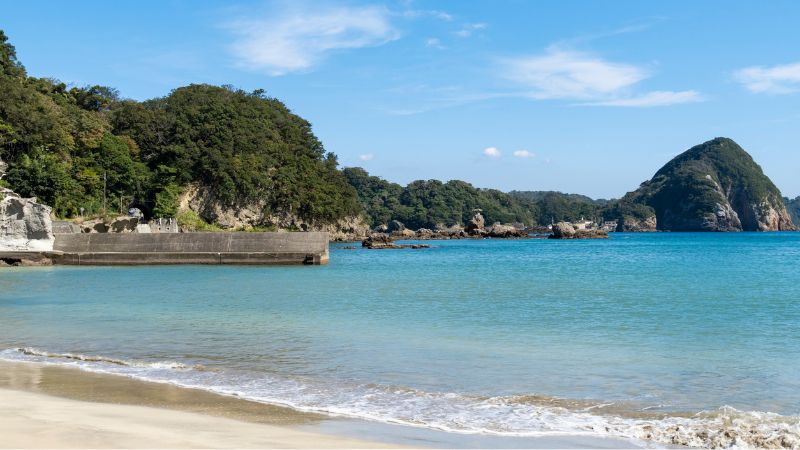
If SHOGUN made you curious about Ajiro and the landscapes that evoke “old Japan,” you’re not alone. Here is a travel guide that combines the drama’s setting with real-world Izu tourism—focusing on history, views, and food.
1.Fictional “Ajiro” vs. the real Ajiro: filming in Canada and the geography of Izu
First, an important fact for trip planning: the series was not filmed in Ajiro, Izu. Major production took place in British Columbia, Canada (around the Vancouver area).
Comparison table
| Feature | “Ajiro” in the series (filmed in Canada) | Real Ajiro (Atami City, Shizuoka Prefecture, Japan) |
|---|---|---|
| Landscape | Conifer forests, rocky and rugged coastlines, often overcast | Mild climate; mountains with broadleaf trees and citrus; calm Sagami Bay |
| Filming sites | Areas such as Minaty Bay and Port Moody | Not a filming location, but the story’s stated setting |
| Overall mood | Heavy, dark, closed-in | A bright hot-spring region with an active fishing port and tourism |
Why real Ajiro is appealing
Real Ajiro is a naturally protected harbor on the east coast of the Izu Peninsula. The steep terrain—mountains rising close to the sea—can echo the drama’s geography, but the atmosphere is different: warmer, more open, and shaped by the comforts of sea and hot springs. Historically, it prospered as a port supporting coastal transport to Edo (old Tokyo).
2.Seeking Japan’s famous dried fish: Ajiro’s food culture and the Himono Festival
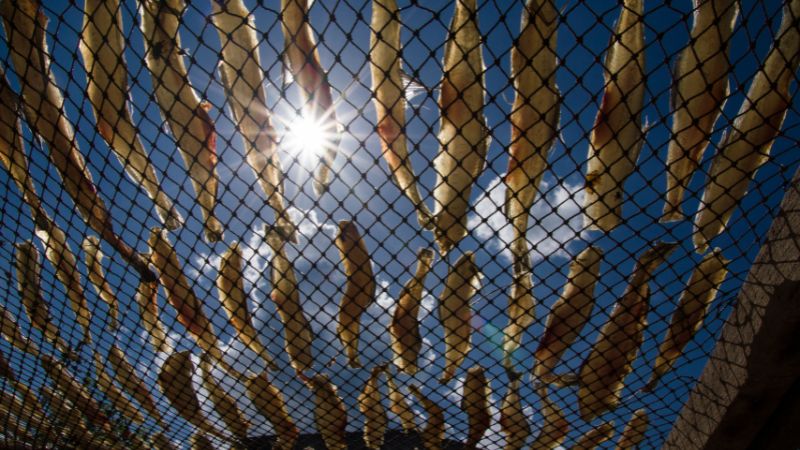
In the series, meals are portrayed as sparse and tense. Modern Ajiro, however, is known as a “himono town”—a place famous for dried fish.
Ajiro’s signature: sun-dried himono
Fresh horse mackerel (aji) is split and dried in the strong Izu sun and sea breeze. The result is simple, intensely flavorful, and deeply local.
Ajiro Onsen Himono Festival
Held in winter (often January to February), this is one of Ajiro’s best-known events. Thousands of dried fish are grilled over charcoal, and visitors may receive free servings. The air fills with fragrant smoke and steam—an image of peace and appetite that sharply contrasts with the drama’s brutal “steam” imagery.
Local favorites: ika-menchi and aji sashimi presentation
- Ika-menchi: a home-style fried patty made from chopped squid and vegetables, known for its bouncy texture
- Aji “sugata-zukuri” presentation: a technique of serving very fresh horse mackerel arranged beautifully with head and tail intact, emphasizing the visual aesthetics of Japanese cuisine
Miura Anjin (William Adams): shipbuilding history and memorial sites in Ito
William Adams—the historical inspiration for Blackthorne—had strong ties to Izu. Ito, located just south of Ajiro, is especially significant.
Site of early Western-style shipbuilding in Japan
Around 1604, under Tokugawa Ieyasu’s orders, Adams is said to have helped oversee the construction of Western-style sailing ships near the mouth of the Matsukawa River in Ito. This achievement strengthened his status and influenced Japan’s maritime knowledge at the time.
Places to visit in Ito
- Anjin Memorial Park: a seaside park with a statue of Miura Anjin looking out to sea
- Tokaikan: a beautifully preserved wooden ryokan building from 1928 (now a visitor facility), where you can appreciate traditional craftsmanship and architecture
- Anjin Festival (August): Ito’s major summer festival celebrating Adams’ legacy, featuring large fireworks over the sea and community events
4.Staying in registered cultural-property ryokan: experiencing traditional aesthetics at Ochiairo and Arai Ryokan
If you want to immerse yourself in the world SHOGUN evokes, consider staying in a traditional ryokan rather than a modern hotel.
Ochiairo (Yugashima, Izu City)
Founded in 1874, Ochiairo is known for architecture recognized as a Registered Tangible Cultural Property in Japan. In particular, intricate woodwork, old hand-blown glass, and master carpentry preserve an authenticity that can feel even more precise than many period sets. In fact, many literary figures once stayed here to write, drawn by the quiet and the sound of the river. Some rooms are named after elements of The Tale of Genji, and private open-air baths can offer a personal, reflective “purification” moment.
Arai Ryokan (Shuzenji Onsen)
Also recognized as a Registered Tangible Cultural Property, Arai Ryokan is especially famous for its large cypress-wood bathhouse, built in 1934. Because it is a protected historic structure, bathing there is a rare experience. It feels very different from the drama’s tense bath scene—and it is designed for deep relaxation.
Access and a recommended itinerary: a “SHOGUN-inspired” pilgrimage (day trip to 1 night/2 days)
Access
- Limited Express Odoriko: from Tokyo toward Izu via the JR Tokaido Line; some services stop at Ajiro Station. Premium variants offer wide-window coastal views over Sagami Bay.
- Shinkansen: take the Tokaido Shinkansen (Kodama) to Atami (about 45 minutes from Tokyo), then transfer to the JR Ito Line to Ajiro (about 15 minutes).
Recommended itinerary (day trip to 1 night/2 days)
| Time | Plan | Highlights |
|---|---|---|
| Day 1 10:00 | Depart Tokyo by Odoriko | Enjoy the coastline; grab a bento and a drink for the ride |
| 11:30 | Arrive Ajiro; walk the himono shops | Harbor-town atmosphere and the scent of sun-dried fish |
| 12:30 | Lunch: aji tataki rice bowl | Fresh seafood, plus local ika-menchi |
| 14:00 | Travel to Ito; Anjin Memorial Park | Meet the statue; visit the Matsukawa area tied to shipbuilding history |
| 15:30 | Tokaikan visit and tea | Traditional wooden architecture; relax by the river |
| 17:00 | Check-in (Shuzenji or Yugashima) | Stay at a heritage ryokan such as Arai or Ochiairo |
| Evening | Hot springs and kaiseki dinner | A restorative, cultural “misogi-like” experience |
| Day 2 10:00 | Explore Shuzenji | Bamboo grove paths and temple visit in a quiet setting |
| 13:00 | Travel to Atami; MOA Museum of Art | See Japanese artworks (tea utensils, screens) that echo the period’s aesthetics |
| 16:00 | Return to Tokyo | Shinkansen or Odoriko back |
Conclusion
Episode 1 of SHOGUN goes beyond historical drama. Instead, it vividly portrays cultural foundations that shape Japan’s worldview: attitudes toward death, ideas of purity, and the language of etiquette. Even though the story’s Ajiro is dramatized—and the series was not filmed in the real town—Izu-Ajiro remains a compelling destination, rich in history, food culture, and the healing tradition of hot springs.
For many travelers today, the “bath” Blackthorne fears becomes the ultimate pleasure of onsen. And the “Japanese heart” he struggles to understand—often expressed through silence, discipline, and ritual—still lives in Izu’s everyday hospitality. So, if you visit Ajiro with the series in mind, you’ll hear the same ocean waves that have sounded for centuries, and you’ll find a landscape that welcomes travelers with a timeless warmth.
If you’d like to explore SHOGUN’s official sites, start here.